
Shasta County Tax Records and Payments
Shasta County property tax records are managed by the Treasurer-Tax Collector office. Property owners search tax bills, view assessed values, and make payments through county online systems. The County Assessor establishes property values each year on January 1 following California Proposition 13 rules. Tax bills are issued twice annually with payment due dates in November and February. Property tax information is public record available at no cost through county portals. Search by parcel number, property address, or owner name to access current bills, payment history, and assessment details for properties throughout Shasta County.
Shasta County Property Tax Details
Treasurer-Tax Collector Office
The Shasta County Treasurer-Tax Collector handles property tax billing and collection for the entire county. Secured property tax bills are mailed twice per year. First installment bills go out in October and are due November 1. They become delinquent at 5:00 pm on December 10 with a ten percent penalty. Second installment bills are due February 1 and delinquent at 5:00 pm on April 10 with another ten percent penalty.
Contact the Tax Collector at 530-225-5511 for assistance with bills, payments, or account questions. The office is located at 1450 Court Street, Suite 227, Redding, CA 96001. Staff can provide duplicate bills, payment receipts, and information about payment arrangements or delinquent accounts.
Shasta County maintains an online payment portal at common2.mptsweb.com/mbc/shasta/tax/search for convenient bill lookup and payment processing. Credit card payments incur a 2.25 percent fee with a minimum charge of $2.50. Electronic check payments have a flat $1.50 fee. Returned payments result in a $77 fee.
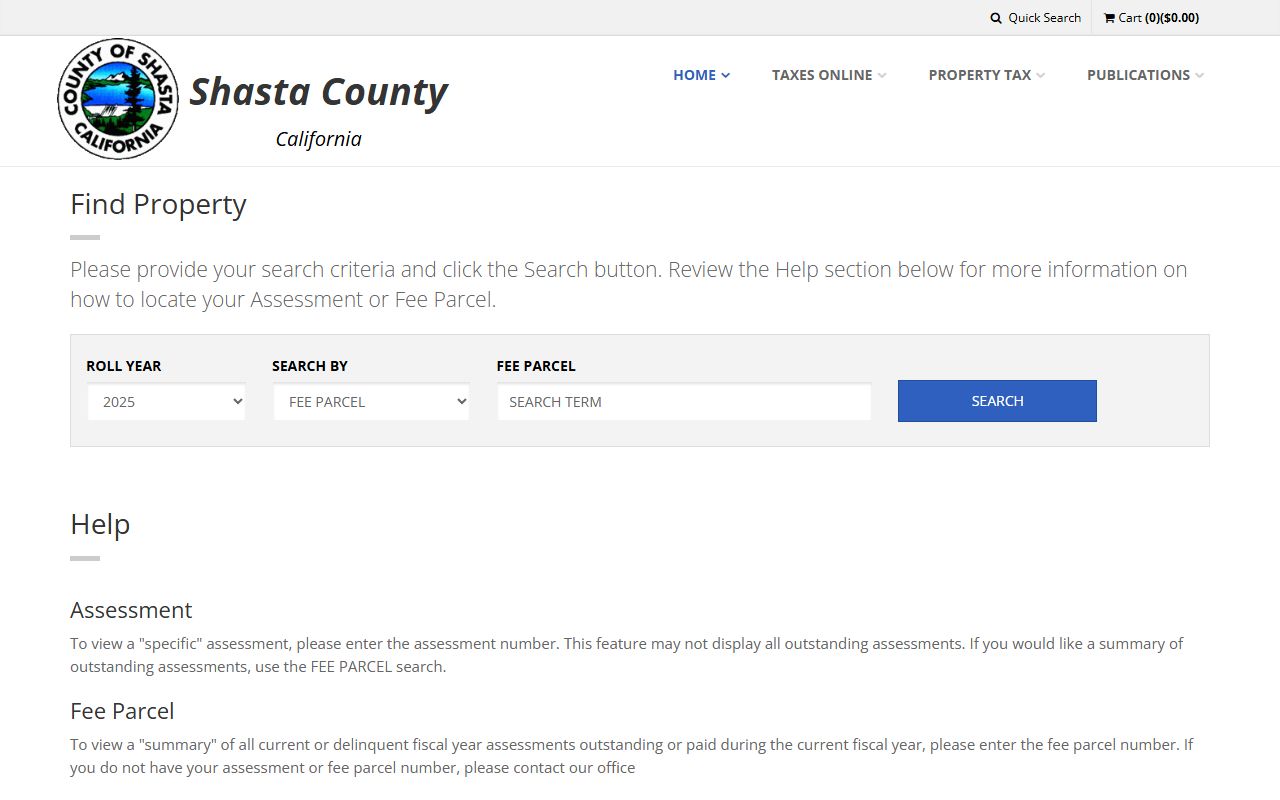
Search Tax Bills Online
The Shasta County tax portal allows 24-hour access to property tax information. Search by entering your Assessor's Parcel Number from your tax bill. You can also search using the property street address with house number, street name, and city. Owner name searches work if you provide the exact name on the tax records.
Search results show your current tax bill with both installments displayed. The portal indicates payment status, amounts due, and deadlines for each installment. You can view prior year bills and payment history. Download bills as PDF files to save or print for your records.
The system displays all charges on your property tax bill including the base one percent tax rate plus special assessments, voter-approved bonds, and district charges. Each item has a description and amount. The total represents all applicable charges for your property based on its location.
Ways to Pay Property Taxes
Shasta County accepts property tax payments online, by mail, and in person. Online payment through the county portal is available 24 hours a day. Credit cards cost 2.25 percent of the payment with a $2.50 minimum. Electronic checks have a flat $1.50 fee. The portal processes payments immediately and provides instant confirmation and receipt.
Mail your check or money order to Shasta County Treasurer-Tax Collector, 1450 Court Street, Suite 227, Redding, CA 96001. Include the payment stub from your tax bill. Write your parcel number on the check. Allow adequate time for mail delivery before the deadline. The postmark date determines timeliness for mailed payments.
Pay in person at the Tax Collector office in Redding during regular business hours. Bring your tax bill. The office accepts cash, checks, money orders, and possibly credit or debit cards. Ask staff about current payment methods and any fees for in-person card payments.
Note: A $77 fee applies to returned payments.
Property Tax Exemptions
Shasta County homeowners can claim the Homeowners' Exemption for a $7,000 reduction in assessed value. The property must be your principal residence where you live most of the year. File the exemption claim by February 15 to receive it for that tax year. Once approved, the exemption automatically renews each year unless you move or sell the property. This exemption saves approximately $70 per year on your tax bill.
Veterans with service-connected disabilities may qualify for additional exemptions. The exemption amount varies based on disability percentage and household income limits. Disabled persons under age 62 can also apply for exemptions if they meet requirements. Contact the Shasta County Assessor for details about disability exemptions and application procedures.
Senior citizens age 62 and older with limited income may qualify for property tax postponement through the California State Controller's Office. This program allows you to defer current year property taxes if you meet income and equity requirements. Interest accrues at five percent per year. Call 800-952-5661 for State Controller program information.
Filing Assessment Appeals
Property owners who believe their assessment is incorrect can file an appeal with the Shasta County Assessment Appeals Board. Regular assessment appeals must be filed between July 2 and September 15 each year. Some counties extend the deadline to November 30. Contact the Clerk of the Board to verify filing periods and requirements for your situation.
Obtain an appeal application from the County Assessor or the Assessment Appeals Board. Fill out the form with property information, your opinion of market value, and reasons for the appeal. Attach supporting evidence like recent sales of comparable properties, professional appraisals, or photographs. The county may charge a filing fee to cover processing costs.
The Board schedules a hearing after you file and sends notice at least 45 days in advance. At the hearing, you present your evidence first. The Assessor then presents their case. The Board reviews all evidence and makes a decision on the correct value. The Board's decision applies to that tax year only. You must file a new appeal each year if you continue to disagree with the assessment.
Understanding Proposition 13
Shasta County follows California's Proposition 13 for all property assessments. When you purchase property, the Assessor sets your initial assessed value at the purchase price. This becomes your base year value. Each following year, the Assessor can increase your value by a maximum of two percent. If market values decline, the Assessor may reduce your assessed value below the prior year amount.
The base property tax rate is one percent of assessed value throughout California. Additional charges for school bonds, special districts, and voter-approved measures can increase the total tax rate above one percent. These additional charges vary by property location within the county.
New construction or additions to your property trigger supplemental assessments. When you complete building projects, the Assessor adds the value of improvements to your base value. You receive a supplemental bill for the added value prorated from completion date to the end of the fiscal year on June 30.
Rural and Mountain Properties
Shasta County includes extensive rural and mountain areas. Properties in these areas range from small cabins to large ranches. Mountain properties often have unique characteristics like steep terrain, limited access, or distance from services. The Assessor considers these factors when valuing properties.
Properties in high fire hazard zones may have special assessment charges for fire protection services. These charges fund local fire districts and emergency services. The charges appear as line items on your tax bill and vary by fire district boundaries.
Forest land in timber production may qualify for special assessment under the California Timberland Productivity Act. This program values timberland based on timber production rather than other uses. Property owners must meet specific requirements and file applications. Contact the County Assessor for information about timberland assessment.
Agricultural and Ranch Properties
Shasta County has agricultural and ranch lands. Agricultural property may qualify for reduced assessment under the Williamson Act or California Land Conservation Act. This program values farmland based on agricultural use rather than development potential. Values are significantly lower than market value for development.
To qualify, property must be in agricultural production. Owners sign contracts committing to agricultural use for ten years. The contracts automatically renew unless canceled. Breaking the contract triggers penalty taxes. Contact the County Assessor for information about agricultural preserve enrollment and requirements.
About Shasta County
Shasta County is located in northern California. The county includes the cities of Redding, Anderson, and Shasta Lake. No cities exceed 100,000 population. All property taxes are collected by the County Treasurer-Tax Collector regardless of whether properties are in incorporated cities or unincorporated areas.
Property tax rates vary by location within the county due to different special districts and voter-approved bonds. The base rate is one percent of assessed value throughout the county. Additional charges for schools, fire districts, and other services add to the base rate in some areas.
Nearby Counties
Shasta County borders several other California counties. Each manages its own property tax system with similar procedures.